Slow SAN?….hybridize it!
Primary Flash storage solutions are quickly addressing the needs of many SAN based applications today. But does it take a wholesale change to meet these needs, or can a cache solution address these requirements? The answer depends on where you are today and how long you have left on your current storage commitment.
Can you answer the following questions:
- Do you know what is slowing you down (which LUNs need to be cached)?
- Do you have an idea on how much cache would be needed to address the throughput requirements?
If you can easily answer these two questions, then the determination to perform wholesale change or not is made much easier.
When analyzing customer environments, most of the time we find there are only one or two applications that are bringing the SAN to its knees. Once the throughput requirements are addressed, it’s not just these applications that reap the benefits, but any other applications or users on the system as well.
When we analyze the data, it is often only about 10-20% of the spinning disks that are holding up the entire system (hot spots). These are the ones that have long response times, lots of commands outstanding. It is not easy to identify these among the hundreds of disks, because their IOPS or MB/s might be high or low. Adding to the difficulty in troubleshooting performance, the hot spots tend to move over time from disk to disk. This could be when different monthly database reports or multiple HD video streams are requested at the same time and they tax throughput capabilities of the relevant spinning disks.
So for most situations, you don’t need to replace the hundreds of spinning disks to gain performance, you just need to address the 10-20% of the hot spots and be able to chase after them when they shift. A solution for solving this problem has been invented tens of years ago: caching. The good news is that plenty of vendors are producing flash storage (or SSD) that are ideal for caching the spinning disks. The bad news is the difficulty in deploying them.
Flash for caching is generally available only at the host level. There are many PCIE based flash cards available in the market today, up to 4TB per card. The issues with deploying the flash cards at each host are:
- Do you have downtime to bringing each server down?
- Do you actually have slots available and can that old server you have a PCIE slot that fits the requirements in terms of space, power, and cooling?
- Is this a cluster? If yes, then most likely you cannot cache at the node level because by “share storage” is a basic requirement of clusters.
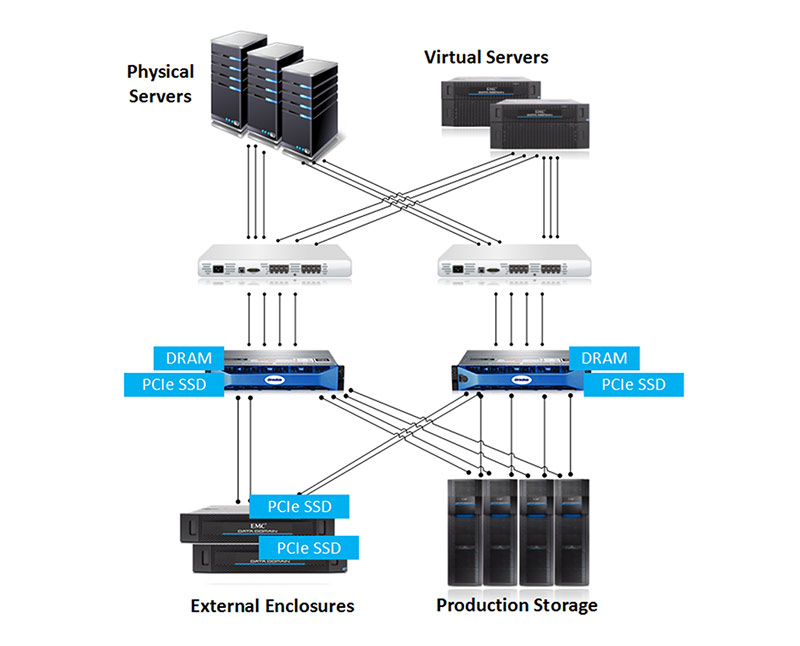
Cirrus Data Solutions developed a Data Caching Server (DCS) that solves all the above elegantly. DCS is an appliance that is installed in pairs (HA) and can be inserted into a live FC SAN without requiring any zoning changes, LUN masking changes, or any host side setting or driver changes. The flash cards are installed in the DCS appliances (standard 2U Linux boxes), thereby eliminating any compatibility issues with your existing server hardware. By caching at the FC SAN layer, the flash storage is shared by all the application servers, even clustered nodes such as Oracle RAC, SQL Clusters, etc. The deployment of the DCS uses a patented technology called Transparent Datapath Intercept which requires no downtime, and therefore can be deployed/removed at will. The DCS has a built-in SAN analyzer that gives you 100% transparency in terms of your overall I/O characteristics. This includes what are the hot-spots, how do they move, how much response time do they cause, which host suffers the most, how much cache do you need to solve the issue. This opens up many use cases:
- Emergency Cache Service
- Deploy anytime to boost IOPS for unexpected load
- Remove and redeploy for another project
- Permanent Immediate Relief of Performance Pain
- Keep DCS as a permanent cache layer to hybridize the existing SAN
- Boosting IOPS to extend Storage Farm Life Cycle
- Value-added Partner’s Cache-as-a-Service Tool:
- Deploy DCS to immediately boost IOPS
- Use DCS to analyze IO, generate detailed reports
- Re-architect customer’s SAN for their next purchase by purchasing the correct ratio of flash and spinning disks.
With DCS you can hybridize your SAN environment without any pain points, get a complete analysis of how your SAN is doing, know what LUN’s are hot, and set cache policies to address the throughput of applications that are bringing your system to its knees. With a patented technology, the benefits of DCS can be tapped without any downtime or any risk of changes to your existing FC SAN.
If you’re not sure if DCS would be the right solutions for you, please take part in our webinar on Thursday June 25 at 12:30 PM EST.
Please see the white paper written by Seagate demonstrating how to increase the throughput in an Oracle RAC environment by five times.
Visit us at Oracle OpenWorld in booth #1740.